Webb telescope finds smallest brown dwarfs yet confirmed, and an atmosphere that shouldn't exist
A new James Webb Space Telescope survey of the star cluster IC 348 has confirmed brown dwarfs as light as twice Jupiter's mass, along with an unexplained hydrocarbon signature that researchers say may define an entirely new class of object.
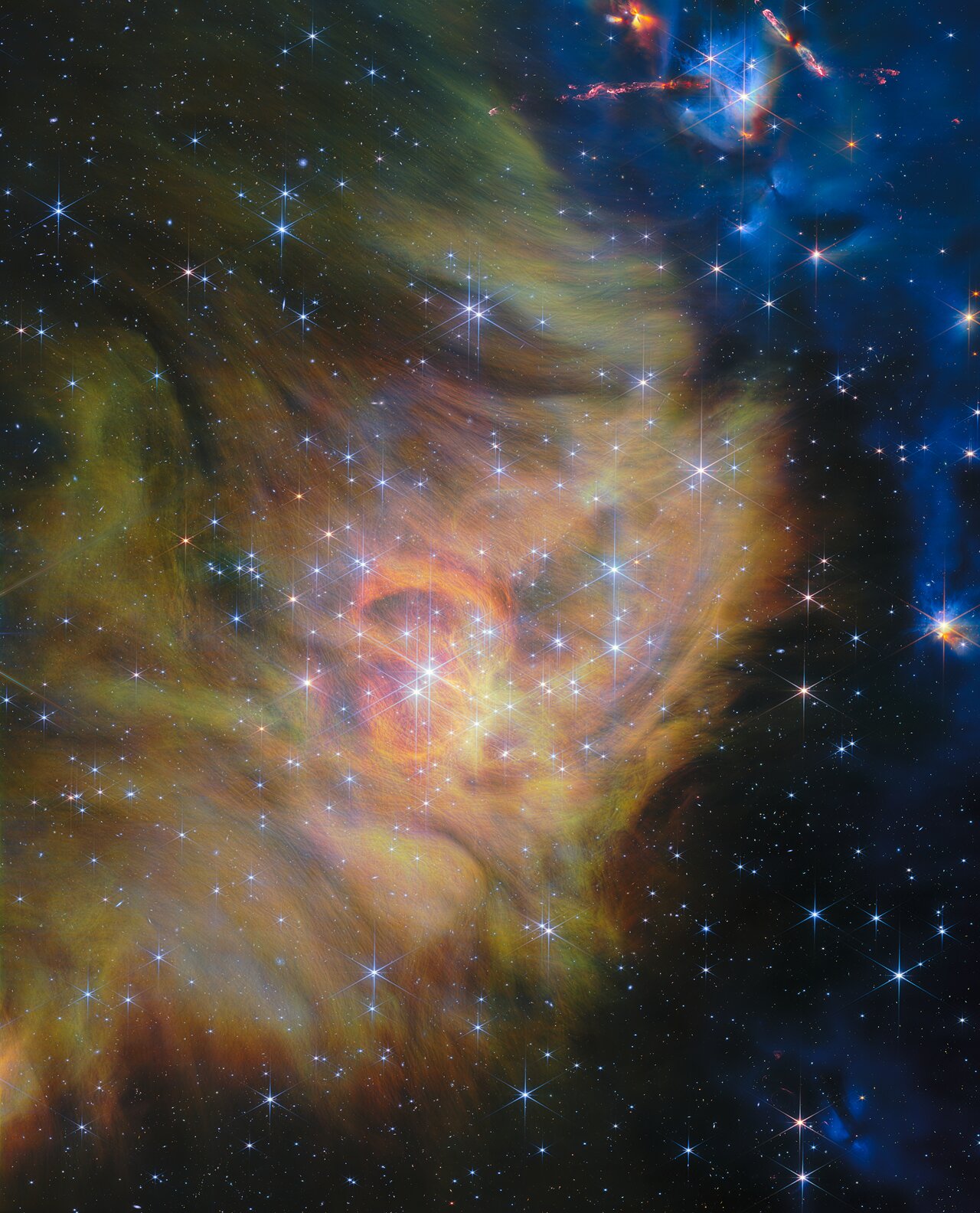
The European Space Agency's Webb telescope office and NASA released one of the largest public images yet taken by the James Webb Space Telescope on Monday, a sprawling mosaic of the star-forming cloud IC 348 that also documents the smallest brown dwarfs ever confirmed by spectroscopy. The faintest of the newly identified objects has an estimated mass of only about twice that of Jupiter, or roughly 0.19 percent of the mass of the sun, pushing the known bottom of the population of "failed stars" into territory few astronomers expected to reach with current instruments.
The results come from a peer-reviewed survey led by Kevin Luhman of Pennsylvania State University and Catarina Alves de Oliveira of the European Space Agency, published in The Astrophysical Journal Letters, and folded into Monday's image release timed to the paper's public rollout. IC 348 sits about 1,000 light-years away in the constellation Perseus, and the new mosaic covers a patch of sky roughly 16 by 20 arcminutes, built from infrared exposures gathered by Webb's NIRCam instrument.
The numbers behind the record
Using NIRCam images taken in 2024, the team flagged 39 candidate brown dwarfs across the cluster based on their colors and brightness. They followed up with spectroscopy from Webb's NIRSpec instrument in February 2025, obtaining usable spectra for 15 of those candidates. Nine were confirmed as young substellar members of the cluster; the rest turned out to be background stars, distant "T dwarf" interlopers or, in two cases, active galaxies whose light happened to fall in the same color range. The faintest confirmed members have estimated masses near 2 Jupiter masses, edging past the previous record of 3 to 4 Jupiter masses that the same two researchers set in the cluster's center in 2023. Two additional NIRCam candidates that still lack spectroscopic confirmation appear to weigh close to a single Jupiter mass. One of the roughly 2-Jupiter-mass objects also shows a large infrared excess consistent with a surrounding disk of gas and dust, making it the least massive known brown dwarf with direct evidence that it retains the raw material for building planets. NIRCam also resolved two close pairs of brown dwarfs as likely binary systems, with separations of roughly 70 and 85 astronomical units and secondary masses below 10 Jupiter masses — a combination rare enough that only two comparable systems had previously been documented elsewhere.
A second, separate finding may prove just as consequential for theorists: eight of the nine new members, plus two previously known brown dwarfs, show an absorption feature near 3.4 microns tied to an unidentified aliphatic hydrocarbon. That signature had previously been seen only in the atmospheres of Saturn and Titan within our own solar system, never around another star, and current atmospheric models do not predict it in brown dwarfs at all. The strength of the feature increases as the objects get fainter and cooler, and the researchers propose classifying it as a new spectral type, "H," standing apart from the established L, T and Y dwarf categories used for brown dwarfs and cool stars.
Three decades of watching one cluster
IC 348 has been a favored hunting ground for substellar objects for nearly 30 years because it is close, dense with roughly 500 known members, and only lightly obscured by the dust of its parent molecular cloud, making faint young objects comparatively easy to pick out. Luhman has surveyed the cluster with ground- and space-based telescopes since the late 1990s, steadily pushing the census toward lower masses as instruments improved. Webb's combination of infrared sensitivity and a compact field of view suited to IC 348's size made it possible, for the first time, to search systematically for objects below about 5 Jupiter masses with the confirmation that only spectroscopy can provide. The current results come from Cycle 3 of Webb's science operations, observing program 4866, which extended the survey area more than tenfold beyond the smaller field the team imaged in 2024.
A test for how stars and planets form
The findings bear most directly on astronomers who model how stars and brown dwarfs form out of collapsing clouds of gas. Brown dwarfs form the same way stars do, through gravitational collapse, but never grow massive enough for their cores to sustain hydrogen fusion. Theoretical models have struggled to explain how objects barely more massive than a large planet could form through that same process, and the new results push the observed minimum mass further down, closer to a hard theoretical floor some models predict near a single Jupiter mass. The unexplained hydrocarbon feature adds a second puzzle: models built for these atmospheres never anticipated a non-methane hydrocarbon appearing at all, and the research newsletter AAS Nova, published by the American Astronomical Society, highlighted the finding as evidence these objects may belong "in a class of their own," inviting new radiative and chemical modeling of the coolest, youngest substellar atmospheres. Astronomers working on other nearby clusters, including a recent Webb survey of the young cluster NGC 1333 in the same Perseus complex, are likely to revisit their own brown dwarf censuses in light of how much lower IC 348's limit has fallen. Counting only members with secure spectral classifications, the researchers tally 227 stars for every 54 brown dwarfs across IC 348's full mass range, a ratio that helps define the cluster's initial mass function, the statistical distribution describing how many objects of each mass a star-forming cloud produces. That distribution is one of the basic inputs used across astrophysics, from estimating how many planet-hosting worlds a young cluster might eventually contain to modeling the total light output of distant galaxies, so a firmer handle on its low-mass end has consequences well beyond the cluster itself.
"One basic question you'll find in every astronomy textbook is, what are the smallest stars? That's what we're trying to answer," said Kevin Luhman, the Penn State astronomer who led the survey, describing the motivation behind the multiyear search.
What comes next
Nineteen additional NIRCam candidates in IC 348 still lack the spectroscopy needed to confirm cluster membership and mass, including two objects fainter than any of the confirmed brown dwarfs; resolving those cases is the team's immediate next step and could push the minimum mass estimate lower still. Separately, explaining the 3.4-micron hydrocarbon feature will require new laboratory and theoretical work on how such molecules could form in a young, cold substellar atmosphere without the ultraviolet-driven chemistry usually invoked for similar features in interstellar dust and meteorites. The wider panorama released this week, one of the largest single fields Webb has made public, is also expected to serve as a reference image for follow-up surveys of the cluster's protostars and the jets of shocked gas, cataloged as Herbig-Haro objects, that appear scattered through the frame. For now, the newly confirmed objects stand as the lightest brown dwarfs yet measured with a spectroscopic mass, a record that is likely to be tested again as Webb's surveys of other young clusters deepen.

Brain implant lets paralyzed patients speak and gesture at once through a digital avatar

Fast radio bursts offer astronomers a new way to trace the universe's missing matter

Ig Nobel Prizes leave the United States for the first time in 35 years, honoring cockroach milk and buried underpants
