Webb Telescope Traces Farthest Known Fast Radio Burst to a Surprisingly Young, Tiny Galaxy
A millisecond radio flash detected by a South African array in 2024 has been pinned to a dwarf galaxy from the universe's early star-forming peak, new Webb telescope data show, more than doubling the distance record for such bursts and bolstering the case that they come from young magnetars.
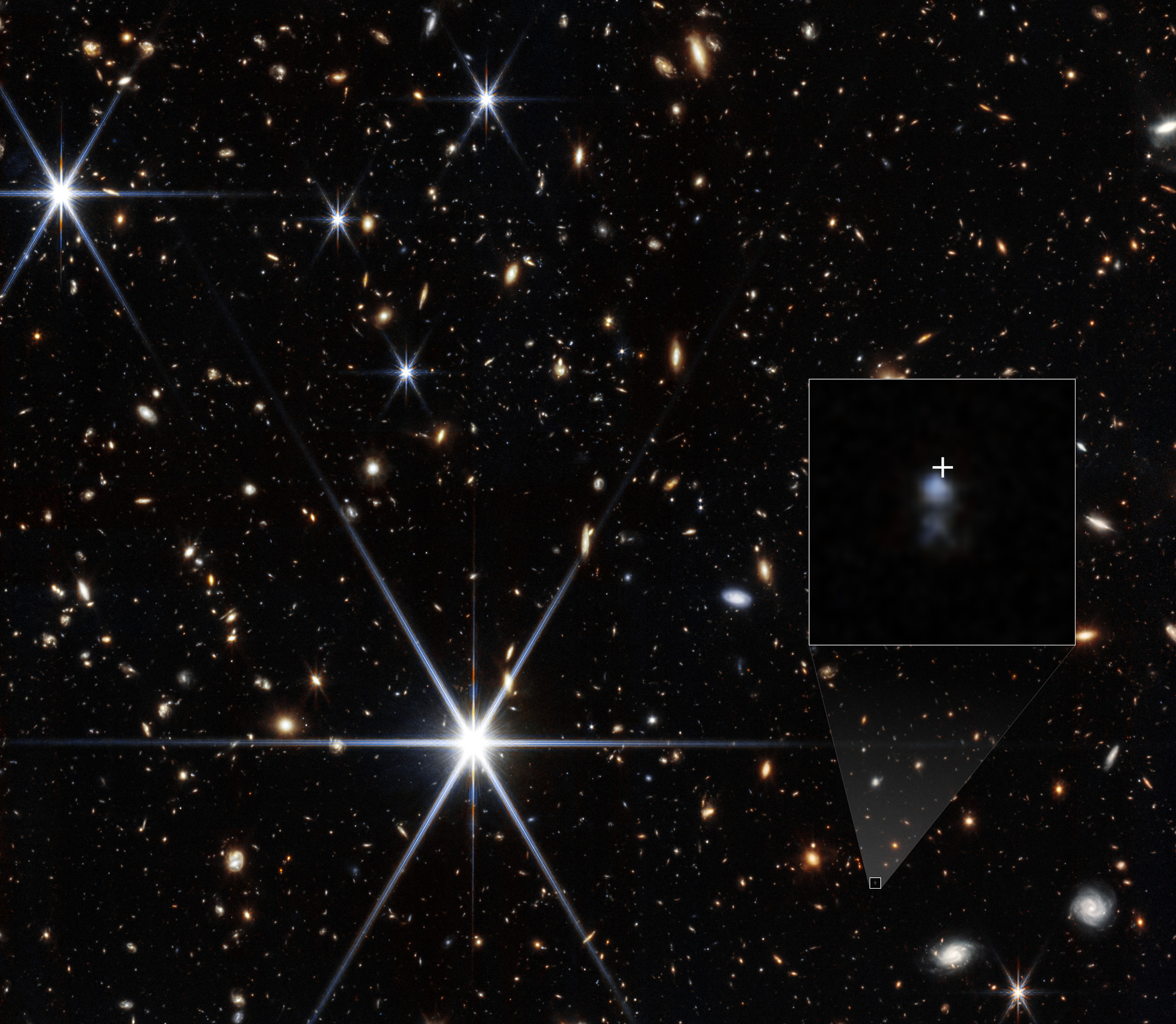
Astronomers have measured the distance to the most remote fast radio burst ever traced to a home galaxy, a millisecond-long flash of radio energy that left its source roughly three billion years after the Big Bang and has been crossing the universe ever since. The finding, published Thursday in the journal Science, more than doubles the distance of any previously localized burst of its kind and points, researchers say, toward a specific and violent origin: a newborn, highly magnetized neutron star known as a magnetar.
The burst, catalogued as FRB 20240304B, was first picked up on March 4, 2024, by the MeerKAT radio telescope array in South Africa. Locating the burst's home galaxy took longer. Ground-based optical and infrared surveys came up empty, so a team led by Manisha Caleb, an astronomer at the University of Sydney, turned to the James Webb Space Telescope, whose infrared instruments can pick out faint, distant galaxies that other telescopes miss.
What Webb found
Webb's NIRCam instrument located a faint smudge of light at the burst's position: a small, compact galaxy caught in the middle of a vigorous burst of star formation. A second instrument, NIRSpec, then split that galaxy's light into a spectrum and picked out the signatures of oxygen and hydrogen, which let the team calculate a precise cosmological redshift of 2.148. That redshift corresponds to a galaxy whose light left home when the universe was about three billion years old, a stretch of cosmic history astronomers call "cosmic noon," when star formation across the universe was near its peak.
The University of Manchester, whose astronomers co-led the ground-based detection effort, said the result roughly doubles the maximum distance at which any fast radio burst has been pinned to a specific galaxy. The previous distance record, set by a burst reported in 2023, now ranks a distant second, as other astronomy outlets covering the result have noted.
A small galaxy for a big event
What surprised the research team was not just the distance but the size of the host. Most fast radio bursts traced to date come from relatively large, well-developed galaxies. This one came from a galaxy the team estimates is roughly a thousand times less massive than they had anticipated, with a stellar population that may have formed in a single, intense burst lasting only about 30 million years — a geological instant by cosmic standards.
That combination — an extremely young galaxy and a burst occurring so early in its life — matters because it bears on one of the central open questions in the field: what actually produces a fast radio burst. Two competing explanations have dominated the debate since the first such bursts were identified in 2007. One holds that the bursts come from magnetars, young neutron stars left behind by the collapse of massive stars, which carry magnetic fields many trillions of times stronger than Earth's. The other holds that at least some bursts come from the collision and merger of two neutron stars, a process that generally takes much longer to unfold after a galaxy's stars have formed.
A galaxy this young and this freshly star-forming favors the first explanation. A neutron-star merger needs time — typically hundreds of millions of years or more — to occur after its progenitor stars are born and die. A galaxy only tens of millions of years into a star-formation episode has not had time to produce a merger of that kind, but it could easily have produced young magnetars.
"A fast radio burst is almost like a cosmic flashlight. We can use the burst and its light to illuminate a lot of the unseen matter in the universe," said J. Xavier Prochaska, an astronomer at the University of California, Santa Cruz, and a co-author of the study.
Reaction from the team
Ben Stappers, a professor of astrophysics at the University of Manchester who led the MeerTRAP detection program at the Jodrell Bank Centre for Astrophysics, said the host galaxy stood apart from the broader population of fast radio burst hosts the team has catalogued. "The host sticks out in the whole galaxy sample that we have. And it was not what we were expecting," Stappers said, according to the Manchester release.
Caleb, the study's lead author, said the team had gone into the follow-up observations with different assumptions. "We thought it would be a big, nicely formed galaxy with lots of stars," she said. Instead, she said, the result argues against one of the leading explanations for at least this burst: "Our work suggests that it's very unlikely that this FRB was produced by a merger."
Kaustubh Rajwade, a co-author at the University of Oxford who led development of the software used to localize the burst within MeerKAT's data, credited the South African array's sensitivity for making the detection possible in the first place. "MeerKAT is uniquely placed to find FRBs at such distances," he said. Themiya Nanayakkara, a co-author at the University of Sydney who worked on the Webb observations, said the telescope's reach let the team confirm a galaxy that ground-based instruments could not even detect, calling it an example of Webb's ability to "push boundaries beyond what was previously possible."
A byproduct: mapping the universe's missing matter
Beyond the burst's origin, its light also served a second purpose on its roughly 11-billion-year journey to Earth: it passed through, and was subtly altered by, ordinary matter it encountered along the way, including gas that does not show up in conventional telescope surveys. In analyzing that imprint, the research team identified a previously uncatalogued galaxy cluster at a more modest redshift of about 0.3, roughly 3.5 billion light-years from Earth, as well as a signature consistent with gas associated with the nearby Virgo Cluster. Astronomers have increasingly used fast radio bursts this way, as probes that can help account for so-called missing baryons, ordinary matter that models say should exist in the universe but that direct observation has struggled to locate.
What comes next
The discovery is also a proof of concept for a search strategy the team expects to repeat. Project scientists involved in the MeerTRAP program say MeerKAT should be capable of detecting and localizing several fast radio bursts a year at redshifts above 1, with the Webb telescope available to chase down the faint, distant galaxies that host them. Researchers say that pace could eventually let astronomers probe fast radio bursts from galaxies that existed when the universe was less than half its current age, building a larger sample that could settle, rather than merely inform, the debate over what triggers these bursts. For now, the result stands as the single most distant fast radio burst with a confirmed home address, and a data point squarely on the side of the magnetar hypothesis.

A Rail System Built From Single Atoms Could Make Superconductors Leak Less Energy

Astronomers Confirm Third "Wandering" Black Hole Caught Shredding a Star Far From Its Galaxy's Core

Lab-Grown Brain Cells Learn to "Read" Braille, Pointing Toward Biohybrid Computers
