Agility Robotics unveils Digit 5, a humanoid built to work beside people without safety cages
The Oregon company's fifth-generation Digit adds an AI-based human-detection system, a 40% higher payload and a faster-charging battery, as it books more than $300 million in orders and moves toward a $2.5 billion public listing.
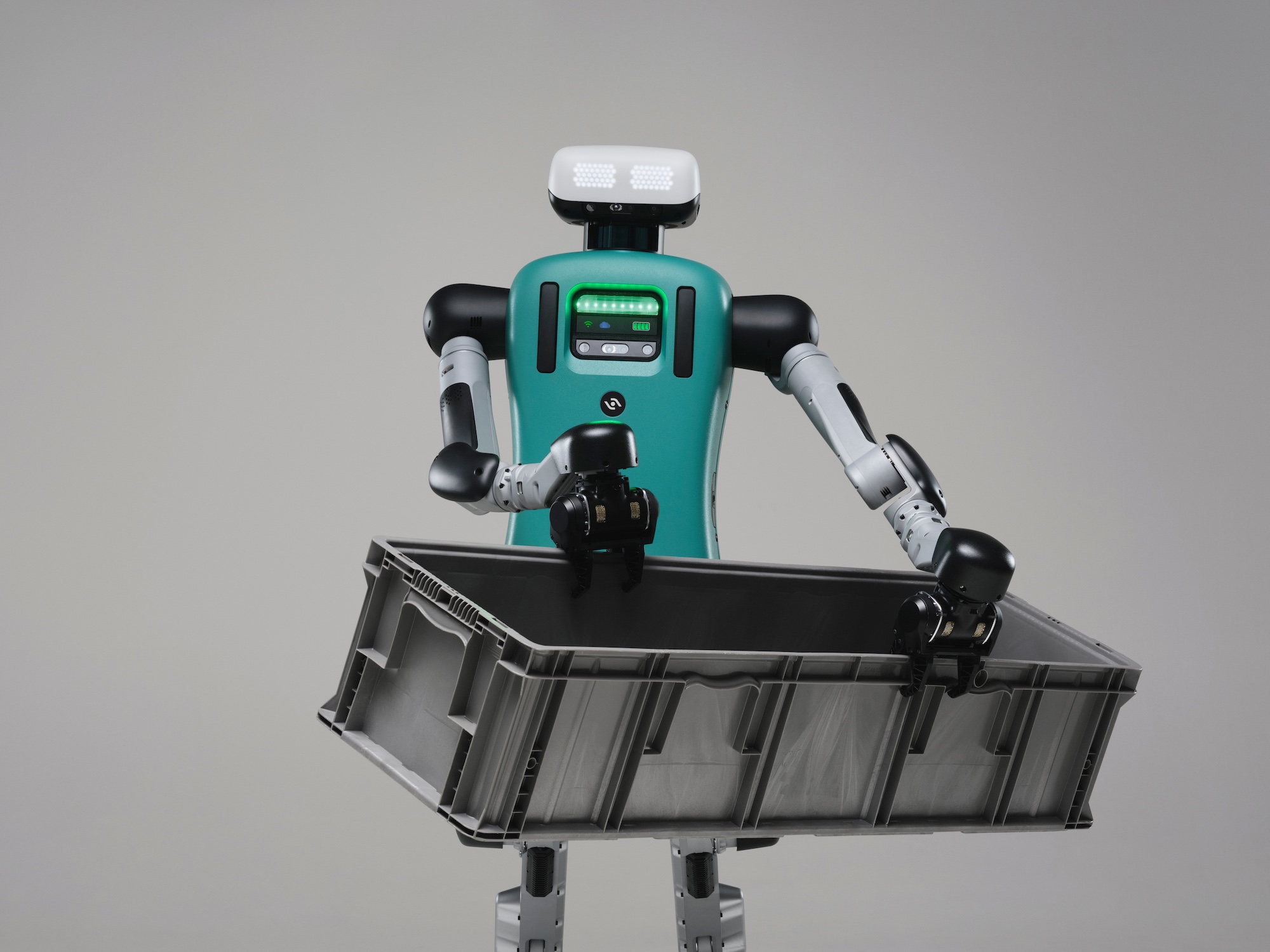
Agility Robotics unveiled Digit 5 on Tuesday, the fifth generation of its two-legged, two-armed humanoid robot and the first version the Oregon company says is built to work in the open alongside people rather than behind fencing or safety cages. The robot is aimed squarely at warehouses, factories and distribution centers, where Agility has spent nearly three years testing earlier Digit models on real shifts.
The redesign centers on a new detection and response system that the company calls cooperative safety: sensors and AI models that let the robot notice a nearby worker, then steer around them, pause or drop into a seated position, with lights and sounds signaling what it is about to do next. Agility says that approach, not just faster hardware, is what has kept humanoid robots largely confined to caged pilot cells even as the industry has raced to build them.
The hardware upgrade
Digit 5 stands 5 feet 11 inches tall, weighs 284 pounds and can repeatedly lift loads up to 50 pounds, a 40% increase in payload over the previous generation. Its new battery runs for 90 minutes and recharges in 9 minutes, which Agility says produces a 10-to-1 run-to-charge ratio, up from roughly 2-to-1 on Digit 4, and enables more than 20 hours of productive work in a 24-hour day. The robot also gets redesigned legs with proprietary cycloidal actuators, padded knees for kneeling, and a swappable gripper system built around ISO-standard mounts so customers can change end effectors for different tasks.
Agility says the current Digit fleet has logged more than 65,000 cumulative operating hours across nine customer sites, including a milestone at a GXO Logistics facility where the robot moved more than 100,000 totes at roughly 98% accuracy. In a filing tied to its pending move to public markets, Agility disclosed more than $300 million in multi-year contracted orders for Digit v5, including a three-year commitment for 1,000 robots from a customer it has not named, plus a pipeline of more than 30 additional prospective customers.
From research lab to warehouse floor
Digit traces back to Cassie, a bipedal research robot built at Oregon State University, and Agility has iterated on the design commercially since Digit's 2019 debut. The company says an earlier Digit unit became the first humanoid to pass an on-site field evaluation, conducted by an OSHA-recognized testing laboratory, against industrial safety standards at a customer fulfillment site — a step it argues was necessary groundwork before robots could work near people without barriers at all.
That safety push got new hardware backing this year through a partnership with Nvidia. Agility is the first company using Nvidia's Halos for Robotics platform, built on the Nvidia IGX Thor computer, to underpin Digit 5's human-detection system. "Physical AI is transforming how factories, warehouses and logistics operations work, and robotics teams need a unified safety architecture to scale autonomous systems into these environments," said Deepu Talla, Nvidia's vice president of robotics and edge AI, in the companies' announcement.
Agility is also moving toward becoming a public company. It agreed in June to merge with blank-check company Churchill Capital Corp XI in a deal valuing the combined business at $2.5 billion, with plans to trade on a major exchange under the ticker AGLT once the transaction closes. The deal includes roughly $200 million in new investment led by Foxconn.
Who is affected
The immediate customers are logistics and manufacturing operators looking to automate repetitive lifting, tote handling and machine-tending work without redesigning facilities around robot-only zones. Agility names GXO, Schaeffler, Toyota Motor Manufacturing Canada and Mercado Libre among current deployment sites, and it plans to certify Digit 5 to the CE mark for its first deployments outside North America, in the European Union and United Kingdom.
Warehouse and factory workers are the group with the most at stake day to day, since cooperative safety is explicitly meant to let the robots share floor space with them rather than stay walled off. Agility frames Digit as filling labor gaps in physically demanding, hard-to-staff roles rather than replacing existing headcount, though the broader humanoid-robotics industry's effect on warehouse and manufacturing employment remains a live and unresolved debate as more companies move these machines from pilots into paid production work.
"Cooperative safety is the critical unlock for scaled humanoid adoption, and our next generation Digit represents an important milestone," said Jonathan Hurst, Agility's co-founder and chief robot officer.
Chief executive Peggy Johnson, who joined Agility in 2024 after leading Magic Leap and a long career at Microsoft and Qualcomm, cast the launch in similar terms, saying Digit 5 removes "a major barrier to scaling humanoid robots in industrial environments" and was built to requirements customers supplied directly. Churchill Capital chairman and chief executive Michael Klein, whose SPAC is taking Agility public, called the company "a humanoid first mover with proven technology, real-world deployments, and enterprise trust" in the merger announcement.
What happens next
Agility plans early customer access to Digit 5 in the first half of 2027, with general availability by the end of that year. Production is set to run through RoboFab, the company's roughly 70,000-square-foot manufacturing facility in Salem, Oregon, which Agility says is designed to eventually build up to 10,000 units a year. The company also points to its work on industry safety standards — including contributions to ANSI/A3 TR R15.108 in the U.S. and Canada and ISO 25785-1 internationally — as groundwork for regulators and insurers evaluating humanoids working near people.
How much of that plays out depends partly on Wall Street: the Churchill Capital merger still needs shareholder and regulatory sign-off before Agility trades publicly, and its own safety architecture will face further scrutiny as more Digit 5 units move from controlled pilots onto shared factory and warehouse floors carrying real inventory.

Apple ships AI-rebuilt Siri to hundreds of millions of iPhones

Microsoft drafts code barring its AI models from resisting shutdown or hiding their reasoning

Federal deadline passes as attackers keep exploiting Cisco, Citrix and Fortinet flaws
