USDA Recalls 167,000 Pounds of Meat Sold Under a Counterfeit Inspection Stamp
Federal investigators say a North Carolina processor shipped raw pork, beef and goat nationwide bearing a fake USDA mark, the agency's highest-severity recall class, with no illnesses reported so far.
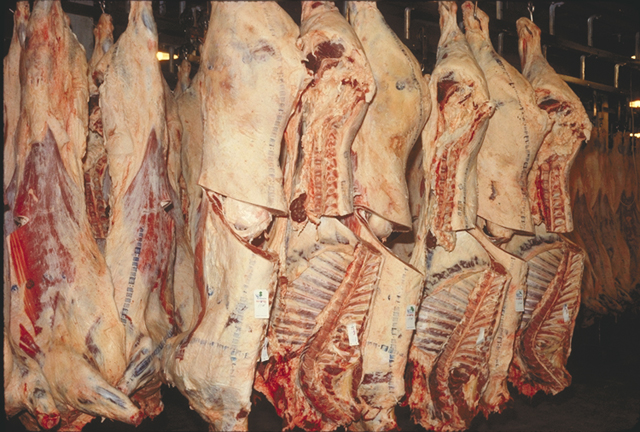
The U.S. Department of Agriculture's Food Safety and Inspection Service ordered a nationwide recall Tuesday of more than 167,000 pounds of raw pork, beef and goat products after federal investigators determined the meat had never passed a government inspector and had instead been shipped out under a counterfeit USDA stamp. The recall was designated Class I, the agency's highest severity level, meaning there is a reasonable probability that eating the product could cause serious illness or death.
The products came from Star Meat Delivery Inc., a small processor in Lucama, North Carolina, roughly 50 miles east of Raleigh. FSIS said the company's output bore a false establishment number, "EST. 1363," printed inside a mark meant to signal that a federal inspector had examined and passed the meat. No such inspection took place. The agency said the problem surfaced during routine FSIS surveillance activities, not from any consumer complaint or reported illness.
The numbers
FSIS put the volume of recalled meat at approximately 167,639 pounds, produced on various dates before September 22. The affected items span more than 20 distinct products, including ribeye slices, chuck, oxtail, short ribs, shanks and feet cuts of beef; ground pork, chorizo, chops, pork feet, ribs, Boston cuts, hocks and menudo mix; and several goat cuts. The meat was shipped in bulk to A&D Foods, a distributor based in Duluth, Georgia, which in turn supplied retailers and restaurants across the country. FSIS has not published a state-by-state list of where the product landed, describing the distribution simply as nationwide, and cautioned that the recall's scope could still grow as its investigation continues. As of the announcement, the agency said it had no confirmed reports of illness or injury tied to the products.
How inspection stamps came to matter
Federal oversight of meat sold across state lines traces back to the Federal Meat Inspection Act, the century-old statute that bars pork, beef and other meat from entering interstate commerce unless it has been examined and passed by a federal or federally approved inspector. The purple ink stamp that results, familiar from butcher paper and packaging nationwide, is the visible proof of that inspection. FSIS says meat produced outside that system carries an elevated risk of undeclared allergens, unchecked pathogens and other contamination, precisely because it skipped the safeguards the law requires. The Star Meat Delivery case is not the only Class I meat recall this year: separate FSIS actions, tracked by the recall-monitoring site Recall Bench, put the agency's 2026 recall and alert count at two dozen through mid-September, ten of them Class I. Foodborne illness remains a persistent public health burden more broadly; the Centers for Disease Control and Prevention says it typically coordinates between 17 and 40 active investigations of multistate foodborne illness outbreaks in any given week, most tied to Salmonella, E. coli, Listeria or Campylobacter.
Star Meat Delivery is not the only operator FSIS has caught this year selling meat under a fabricated inspection mark. In August, the agency recalled roughly 24,900 pounds of buffalo chicken products from Shanghai Ravioli Corporation, a Boston company, after finding the items, sold into foodservice kitchens across five New England states, carried a false establishment number rather than a genuine one. A year earlier, Sabrositos Hondurenos LLC, based in Edison, New Jersey, recalled about 32,000 pounds of chorizo, pork chops and ribs sold under the Olancho brand after FSIS investigators found the same pattern: a fabricated inspection stamp on meat shipped to retailers and restaurants nationwide. In each case, including the one announced Tuesday, FSIS said it identified the problem through its own surveillance of products already in commerce, not because a consumer or a business flagged an illness. The recurrence has drawn attention to how such operations manage to reach national distributors before regulators intervene, though FSIS has not said whether the cases are connected.
Who is affected
Because A&D Foods distributed the meat in bulk to both retail counters and restaurant kitchens nationwide, FSIS is not limiting its warning to a single region. The agency's guidance applies broadly: anyone who bought raw pork, beef or goat bearing the "EST. 1363" mark, whether from a grocery meat case or a restaurant supplier, is covered by the recall. Retailers and restaurants that received the product are instructed not to sell or serve it. Consumers who are uncertain whether meat they purchased came from this supply chain are advised to ask their grocer or, for restaurant meals already eaten, to watch for gastrointestinal symptoms in the days that follow, though FSIS stressed no illnesses have yet been linked to the case.
"In many cases, a recall is evidence that the food-safety system is working as it was designed to work," said Keith Schneider, a food safety professor at the University of Florida's Institute of Food and Agricultural Sciences, speaking generally about how the recall process functions rather than about the Star Meat Delivery case specifically. "We cannot make food completely risk-free. The important thing is having systems that can identify a problem, determine how serious it is, identify the affected product and remove it from store shelves or consumers' hands."
Schneider's comment, made to Newsweek as the recall drew national attention, reflects a broader argument among food-safety researchers: a recall driven by inspectors' own surveillance, as this one was, is typically read as the oversight system catching a problem before it caused documented harm, rather than evidence the system failed. Newsweek's reporting on the recall noted that Star Meat Delivery had not responded to requests for comment by the time of publication.
What happens next
FSIS is telling consumers who have purchased the recalled products not to eat them. The agency's standard instructions apply: throw the meat away in a secure container, or return it to the point of purchase for a refund. Restaurants and retailers that received shipments are being asked to pull any remaining product immediately rather than wait for a formal product-by-product notice, given how many individual cuts and labels are involved. FSIS said its investigation into Star Meat Delivery and its distribution network remains open, and the agency has signaled the list of recalled products could expand as it traces further shipments. Consumers with questions about the recall, or about safe handling of meat, poultry and egg products more broadly, can reach the USDA's Meat and Poultry Hotline, a live service staffed by food safety specialists on weekdays. No timeline has been given for when the investigation, or the broader question of how the plant operated for an unspecified period without federal inspection, will be resolved.

Wakefern recalls ShopRite-brand organic applesauce after mold toxin exceeds safety limit

FDA widens warning on weight-loss supplements laced with a poisonous plant

CDC Survey Finds Teen Mental Health Improving, but a Narrower Report Draws Scrutiny
