Astronauts complete 100th U.S. spacewalk, install station's seventh new solar wing
NASA's Anil Menon and the Canadian Space Agency's Joshua Kutryk spent more than seven hours outside the International Space Station installing a solar array, in a milestone spacewalk that was also Canada's first in nearly a decade.
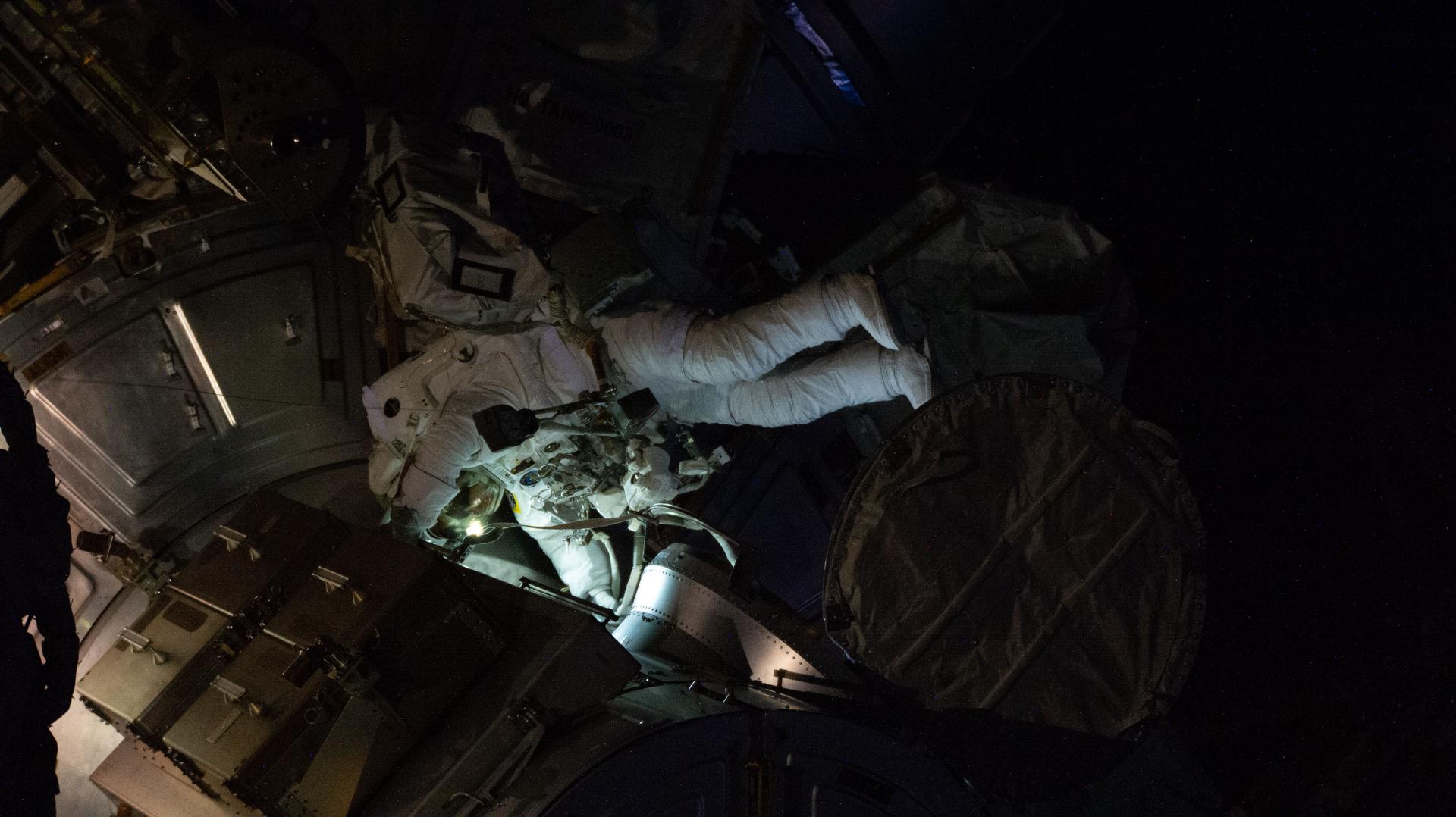
Two astronauts spent seven hours and 11 minutes outside the International Space Station on Thursday, installing a new solar array in a spacewalk that NASA designated its 100th since station assembly began — and the first by a Canadian astronaut in seven years.
NASA astronaut Anil Menon and Canadian Space Agency astronaut Joshua Kutryk exited the station's Quest airlock at 7:57 a.m. EDT on October 29 and returned at 3:08 p.m., according to NASA's mission blog. Their task was to install and unfurl an International Space Station Roll-Out Solar Array, known as an iROSA, on the station's 2A power channel — the seventh such array bolted onto the orbiting laboratory since 2021. It was Menon's fourth spacewalk and Kutryk's first, and NASA counted it as the 285th spacewalk conducted in support of station assembly, maintenance and upgrades.
Replacing Power That Has Quietly Faded
The station's original solar wings, completed in March 2009 with the installation of its final truss segment, have lost a measurable share of their output after more than two decades of exposure to atomic oxygen and radiation in low Earth orbit. Rather than replace them outright, NASA began layering newer, smaller iROSAs directly over the existing arrays in June 2021, when astronauts Shane Kimbrough and Thomas Pesquet installed the first two on the 2B and 4B power channels. Each array ships to orbit rolled into a compact cylinder and unfurls to tens of feet in length once bolted onto the existing mast. Later pairs arrived aboard SpaceX cargo flights through 2022 and 2023, bringing the total to six before Thursday's addition, all without ever taking the station's power system offline.
At an October 20 technical briefing previewing the two remaining installations, Gaurang Patel, operations integration manager for NASA's Low Earth Orbit Program, said the completed set of arrays would raise the station's total power generation capacity by as much as 30 percent — from roughly 160 kilowatts to about 215 kilowatts.
"[This upgrade will] increase our power generation capability up to 30 per cent," Gaurang Patel, NASA's Low Earth Orbit Program operations integration manager, said at the agency's October 20 briefing.
NASA has said the added power is needed not only for day-to-day research and life support but for the station's eventual retirement. The agency has committed to operating the station through 2030, when a modified SpaceX Dragon capsule, contracted for as much as $843 million, is expected to guide the complex through a controlled reentry over a remote stretch of ocean. That deorbit vehicle will need three to four times the power generation of an ordinary cargo Dragon to carry out the maneuver, according to NASA and SpaceX, one reason officials have pointed to the station's overall power budget, and not just its research needs, as motivation to finish the array upgrade before retirement.
A Canadian Milestone in a Supporting Role That Built the Station
For the Canadian Space Agency, Thursday's excursion carried extra weight. Kutryk, a colonel who arrived at the station on October 1 aboard SpaceX's Crew-13 mission for a six-month stay, became only the fifth CSA astronaut ever to conduct a spacewalk, and the first since 2019 — a gap Space.com noted stretched Canada's spacewalking drought to seven years. A former fighter and test pilot in the Royal Canadian Air Force with more than 4,000 flight hours across roughly 40 aircraft types, Kutryk was selected for the Canadian astronaut corps in 2017 and completed astronaut candidate training in 2020. Menon, his spacewalking partner, is a physician and colonel in the U.S. Space Force who worked as SpaceX's first flight surgeon, helping prepare the company's first crewed launch in 2020, before joining NASA's astronaut corps in 2021; he launched to the station aboard Soyuz MS-29 in July 2026 for an eight-month mission.
Canada's contribution went beyond a single astronaut outside the hatch. Each rolled-up array had to be moved from its stowed position to its installation site by Canadarm2, the Canadian-built robotic arm that has serviced the station since 2001. The arm rides the station's Mobile Base, a platform that glides along rails on the main truss atop a separate rail car, giving it access to worksites spread across the station's full length — but because Canadarm2 cannot relocate itself while carrying a payload, ground teams first had to reposition and re-power the base at each new worksite before the arm could lift an array into place. According to SpaceQ, flight controllers at the CSA's Robotics Mission Control Centre in Longueuil, Quebec, planned and tracked that choreography in real time, NASA astronaut Luke Delaney commanded the arm from inside the station, and CSA astronaut Jenni Gibbons served as capsule communicator at NASA's Johnson Space Center, relaying instructions between Houston and the two spacewalkers.
- Spacewalk duration: 7 hours, 11 minutes (7:57 a.m.–3:08 p.m. EDT, October 29, 2026)
- Task completed: installation and deployment of the station's seventh iROSA solar array, on power channel 2A
- Milestone: U.S. Spacewalk 100 overall; first Canadian spacewalk since 2019
- Power impact: full eight-array upgrade will lift station capacity from about 160 kilowatts to about 215 kilowatts
One Array Left to Go
The astronauts also used part of Thursday's excursion to complete preparatory "get-ahead" tasks for a second spacewalk, U.S. Spacewalk 101, scheduled for November 5. Menon and Kutryk are expected to install the eighth and final iROSA, on power channel 3B, which NASA says will complete the station's six-year power-augmentation campaign. An earlier spacewalk in August, during which Menon helped build a mounting kit on the station's Starboard 6 truss, laid the groundwork for that remaining installation.
With the November spacewalk, NASA will have installed all eight new arrays it planned when the iROSA program began delivering hardware to the station in 2021, closing out a project that has unfolded across more than a dozen spacewalks without ever taking the station offline.
NASA — Spacewalkers Install Roll-Out Solar Array for Power Generation
Space.com — ISS astronaut will conduct Canada's 1st spacewalk in 7 years on Oct. 29
SpaceQ — Weekly ISS Update: Bigger Canadian Role, Kutryk's Spacewalk
Canadian Space Agency — Launch of CSA astronaut Joshua Kutryk to the ISS
NASA's TRACERS satellites find Earth's magnetic shield breaks open in shifting spots, not shifting intensity

Photonic chip combines starlight from two telescopes in milestone test at California observatory
