Giant rock carving in Sudan may depict an ancient Kushite ruler
A newly published survey of Sudan's Mahas region has documented a monumental petroglyph, later enclosed by a seventh-century church, that researchers say may be a rare portrait of a ruler from the Kingdom of Kush.
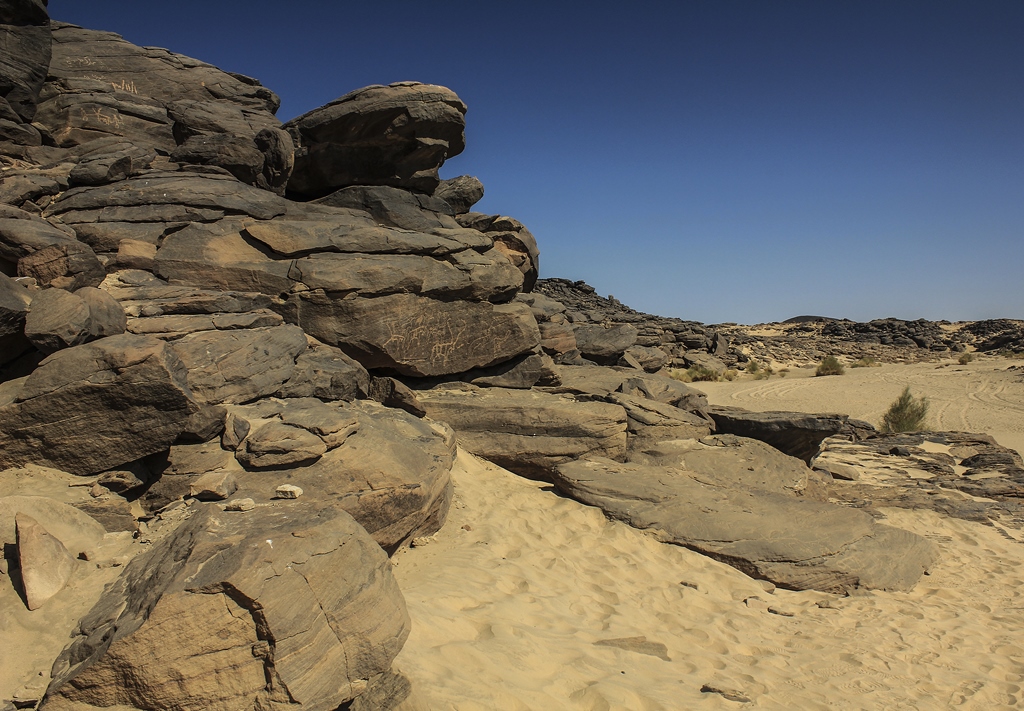
A monumental carving pecked into a granite outcrop beside the Nile in northern Sudan may be a rare portrait of a ruler of the ancient Kingdom of Kush, according to a new survey of the surrounding region. The life-size figure sits at a site later chosen, more than a thousand years afterward, as the location for a Christian church — a juxtaposition researchers say marks the spot as a place of enduring significance across radically different eras and cultures.
The findings come from a paper published in the journal Antiquity on 24 September, describing fieldwork in the Miseeda area of Sudan's Mahas region, on a stretch of the Nile known as the Third Cataract. The team, led by Joanna A. Ciesielska and including researchers from the University of Warsaw's Faculty of Archaeology, the Polish Academy of Sciences and Jagiellonian University, surveyed nearly 300 archaeological sites, most of them previously unrecorded.
What the survey found
The carving itself sits on a granite hill alongside other large images pecked into the rock: a lion, what may be a rhinoceros, an elephant and several smaller depictions of cattle. Researchers describe the central figure as a "monumental representation" that is unusually large and rare for the region, and say it possibly depicts a ruler associated with the Kingdom of Kush, the Nile Valley civilization whose kings conquered and ruled ancient Egypt as its 25th dynasty in the eighth and seventh centuries BCE. Its precise date is unresolved: earlier assessments proposed either a date in the Kerma period or, more broadly, sometime within the Kushite era, a span running roughly from the ninth century BCE to the fourth century CE, and the paper's authors say a more exact date "remains to be established."
Centuries later — in the seventh century CE, long after Nubia's conversion to Christianity — builders raised a small church directly around the older carving, designated site MAS.021 in the survey. Pottery recovered from the church points to trade or workshop links with both the Kingdom of Nobadia and the Kingdom of Makuria, two medieval Christian Nubian states.
- 294 archaeological sites recorded across the Miseeda survey area, 13 previously known and 281 newly identified
- Petroglyph possibly dated to between roughly the ninth century BCE and fourth century CE
- Church built around the carving in the seventh century CE
- Settlement activity peaked during the Mesolithic (about 12,000–8,200 years ago), the Late Neolithic/pre-Kerma period (roughly 3000–2500 BCE) and the medieval Christian era (sixth to fifteenth centuries CE)
A frontier revisited across millennia
The Miseeda survey builds on fieldwork that began in the project "The Good Shepherd of Miseeda," which set out to understand why the rock image bore a resemblance to early Christian depictions of a shepherd figure, and grew into a broader study of how the landscape was used and reused over time. An earlier season of that fieldwork was reported in 2023 in the journal Polish Archaeology in the Mediterranean. The new Antiquity paper extends that work with GIS spatial analysis and rock-art documentation across the wider Mahas region, adding to a body of research on Nubia, a civilization whose monuments and history have long been overshadowed in public awareness by those of neighboring Egypt. The fieldwork was funded by Poland's National Science Centre, and the wider survey has already drawn coverage from science-news outlets summarizing the newly published findings since the paper appeared.
Sparse evidence survives from the Classic Kerma period through much of the Kushite era at Miseeda itself, the researchers note, which makes the scale of the carving — and its placement on what the team describes as a cultural and geographic borderland — more striking. The site sits at the edge of zones historically associated with different Nile Valley powers, and the authors argue that its long, uneven history of use reflects a landscape whose social meaning persisted even as the people and beliefs controlling it changed.
A church with two names
The archaeology has a living counterpart in how nearby residents regard the site today. According to the researchers, the community once treated the church as a place of pilgrimage, but that reputation has shifted over time: some local people now call the building "Beit Kitchiner" or "Beit Sheitan," names associated with both curse and miracle, while the main focus of local devotion has moved to a separate shrine dedicated to a holy man known as Sheikh Kuman. The old rock carving and the church built on top of it, in other words, are no longer the area's primary sacred site — though the researchers argue the location never entirely lost its significance.
"The church at Miseeda, erected in the seventh century around the much older petroglyph, appears to have developed around a site that had retained social significance over millennia," Ciesielska and her co-authors write in the study.
What happens next
The paper is a project-gallery report, the shorter format Antiquity uses for preliminary results, and the authors frame the carving's identification and dating as provisional rather than settled. Pinning down when it was made, and confirming whether it depicts a Kushite ruler rather than another elite or ritual figure, will likely require further excavation and comparison with rock art elsewhere along the Nile cataracts, where petroglyphs spanning thousands of years are common but rarely studied in relation to the later structures built around them. For now, the Miseeda findings add one more data point to a stretch of the Nile that, according to the survey, was never as marginal as its remoteness might suggest.
University of Warsaw, Faculty of Archaeology — Miseeda: church and surroundings, Mahas region, Sudan
Phys.org — Mysterious giant carving may show a Kushite ruler and mark an ancient borderland
Polish Archaeology in the Mediterranean — Archaeological survey in Miseeda, Sudan (season 2022–2023)

New Fossil Species Suggests Dinosaur Flight Evolved Twice, Independently

Scientists in China identify new tick-borne virus behind unexplained fevers

South Korean researchers build a stacked chip that remembers motion as it happens
