Hubble Finds a Ten-Sided Wave Circling Saturn's South Pole
A newly identified decagon-shaped atmospheric wave gives Saturn's famous northern hexagon an unexpected, larger and still-evolving counterpart at the opposite pole.
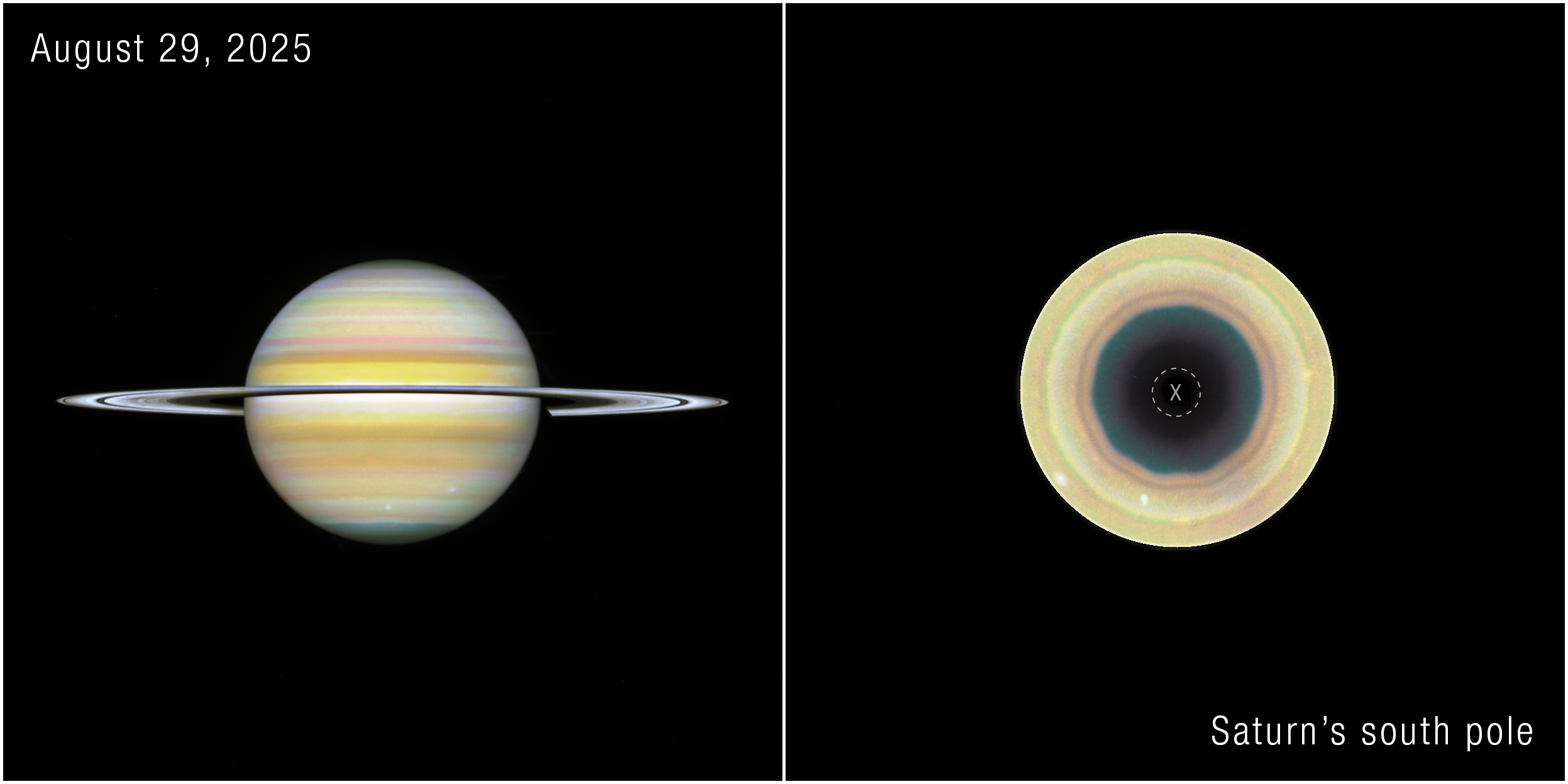
Astronomers using the Hubble Space Telescope have identified a giant, ten-sided wave pattern circling Saturn's south pole, a structure with no confirmed match anywhere else in the solar system. The finding, published Wednesday in the journal Science Advances, gives Saturn's long-known northern hexagon an unexpected southern counterpart that is larger, less stable and apparently still forming.
The decagon sits in the planet's high southern latitudes, riding along a jet stream the way the hexagon does at the north pole. Unlike its northern relative, which has kept the same shape and position since it was first identified in data from the Voyager flybys, the new feature shows uneven shading from side to side and vertices that wobble measurably over time, evidence to the research team that it may be a younger, still-evolving phenomenon rather than a settled fixture of Saturn's atmosphere.
Its apparent novelty may be partly an accident of viewing geometry. Saturn's axial tilt carries each pole in and out of view from Earth over the course of the planet's 29-year orbit, and the south pole was tipped away and largely unobservable between roughly 2017 and 2023, the same stretch during which the wave is thought to have formed. That blind spot means the decagon could have taken shape unnoticed until Hubble's viewing angle improved enough for both professional and amateur observers to catch it.
The numbers behind the pattern
The decagon spans roughly 104,250 miles (167,820 kilometers) across, with each of its ten sides running about 10,425 miles (16,782 kilometers) long. That makes it roughly five times wider than the hexagon, which measures about 20,000 miles (32,000 kilometers) across and sits near 78.5 degrees north latitude. The decagon occupies a band between roughly 58 and 63 degrees south.
The structure itself moves sluggishly, drifting eastward at only about 2.5 meters per second, even though the jet stream it rides within moves at roughly 116 meters per second at that latitude. Researchers also measured the wave's ten corner points oscillating back and forth in longitude by four to eight degrees on a repeating 32-day cycle, a level of internal motion the fixed-looking hexagon does not show. Hubble imagery used to characterize the feature was captured on August 29, 2025, with the telescope's Wide Field Camera 3, shown in a color composite of the planet's south pole alongside a single-filter view isolating the wave pattern released by the space agency.
Atmospheric scientists have long attributed polygonal jet patterns such as the hexagon to Rossby waves, standing oscillations that form when a fast, narrow jet stream becomes mildly unstable and locks into a fixed number of lobes rather than tracing a smooth circle. Why Saturn's atmosphere would produce six lobes at one pole and ten at the other, rather than some other number at either, is not addressed by the new observations and remains an open question the discovery raises rather than settles.
A sibling to the northern hexagon, four decades on
Saturn's hexagonal jet stream at the north pole has been tracked since it turned up in reprocessed Voyager 1 and Voyager 2 data from the early 1980s, making it one of the most recognizable weather features in the solar system. Ground-based observers, including amateur astronomers Trevor Barry and Jean-Paul Oger, first flagged a faint undulating band near Saturn's south pole in 2024. Once alerted, the research team went back through archival Hubble frames and found the wave had already been present, if less distinct, in 2023.
Much of the evidence for how the decagon has evolved since then came not from professional telescopes but from a network of amateur planetary imagers who submit their pictures to a shared archive maintained by Sánchez-Lavega's research group in Bilbao. Cross-checking those ground-based images against Hubble's less frequent observing windows let the team track the wave's ten vertices from month to month through 2025, rather than relying solely on the handful of Hubble visits Saturn typically receives each year.
The confirmation came through NASA's Outer Planets Atmospheres Legacy program, which has photographed Jupiter, Saturn, Uranus and Neptune with Hubble on a near-annual cadence since 2014 specifically to catch slow-building atmospheric changes that a single flyby mission would miss. Lead author Agustín Sánchez-Lavega, a planetary scientist at the University of the Basque Country in Spain, has been checking Hubble images for a southern match to the hexagon since 1990, reasoning that Saturn's north-south jet symmetry made one plausible, according to the space agency's account of the discovery.
What researchers are watching for next
Nothing about the decagon changes conditions for anyone on Earth; Saturn's atmosphere has no direct bearing on human affairs. Its significance is for planetary science, where the find complicates a tidy assumption. For nearly forty years the hexagon stood as a singular oddity, cited in textbooks as an example of an atmospheric pattern unique to Saturn. A second, markedly different polygon on the opposite pole suggests that regular-sided jet waves may be a more general feature of giant-planet atmospheres than the hexagon alone implied, and that Saturn's two poles do not necessarily behave as mirror images of each other.
"The northern hexagon has been there every time we've looked for more than 40 years. This feature is different — it appears to be strengthening," said Amy Simon, principal investigator of the OPAL program at NASA's Goddard Space Flight Center and a co-author of the study.
Simon summed up the puzzle the team now faces more directly: "The question is, why did it suddenly form now when we haven't seen one before?" Cassini, the NASA spacecraft that orbited Saturn from 2004 to 2017 and photographed the northern hexagon in extraordinary detail, never reported a comparable structure at the south pole during its thirteen years at the planet, which is consistent with the new wave being either genuinely recent or simply unobservable during that mission's operating years.
Simon and her colleagues, including co-author Michael Wong of the University of California, Berkeley, say the more pressing task now is determining whether the decagon will settle into a permanent shape or continue to change, the way it has since it was first noticed. The team plans continued monitoring with Hubble alongside the OPAL program's regular imaging, and hopes to bring the James Webb Space Telescope's infrared instruments to bear on the same latitudes to probe deeper atmospheric layers than Hubble's visible-light cameras can reach. Numerical atmospheric models are also being developed to test whether the same jet-stream instabilities thought to sustain the hexagon could produce a ten-sided analog under slightly different conditions.
Because the decagon appears to still be changing shape, researchers say the coming Saturn observing seasons, as the planet's south pole gradually rotates back into better view from Earth, should show fairly quickly whether the pattern is settling down or continuing to evolve. That, more than the geometry itself, is what has caught the attention of the atmospheric scientists who first went looking for it in 1990 and did not expect to actually find it.

September Ranks as Earth's Second-Warmest on Record
Google Cuts a Key Quantum-Computing Error 40-Fold in First Real Hardware Test

A common salt mineral could preserve signs of life inside Enceladus's ocean, study finds
