LUX-ZEPLIN detector records single unexplained signal in dark matter search
The LZ experiment, buried nearly a mile underground in South Dakota, detected one xenon-recoil event that resembles a dark matter interaction — intriguing, researchers say, but far short of the statistical threshold needed to claim a discovery.
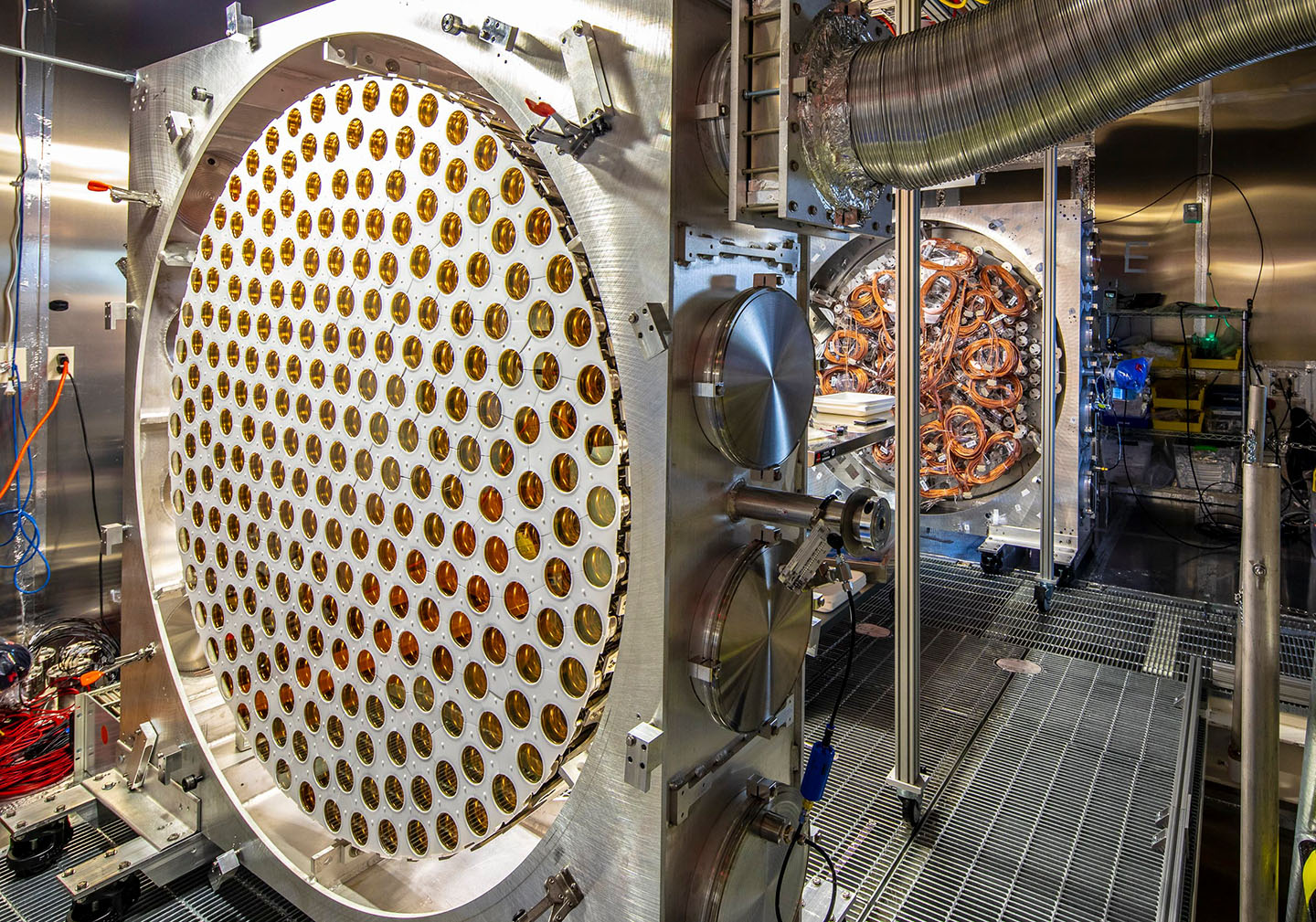
Physicists working on one of the world's most sensitive dark matter detectors have recorded a single, unexplained particle interaction that they say is the most intriguing signal the experiment has yet produced, though they are stopping well short of calling it a discovery.
The result comes from the LUX-ZEPLIN (LZ) experiment, a tank of ultra-pure liquid xenon buried nearly a mile underground in South Dakota. Researchers with the international LZ collaboration presented the finding on September 1 at the TeV Particle Astrophysics conference in Japan and simultaneously posted a paper describing it, which has been submitted to the journal Physical Review Letters. The announcement was detailed in a release from the Lawrence Berkeley National Laboratory news center, which manages the experiment for the U.S. Department of Energy.
The event in question is a single instance of a xenon nucleus recoiling with an energy that the collaboration cannot comfortably attribute to any known source of background radiation, in a part of their data where such backgrounds are expected to be especially rare. It sits in the range where theorists predict a heavy, weakly interacting massive particle, or WIMP, would leave its mark if it collided with a xenon atom. WIMPs remain the leading, though still unconfirmed, candidate for the particle that makes up dark matter.
The numbers behind the signal
The finding is drawn from 220 live-days of data collected between March 2023 and April 2024, amounting to an exposure of 2.84 tonne-years within the detector's active volume of seven tonnes of liquid xenon, out of ten tonnes in the tank overall. The single candidate event registered a nuclear recoil energy of 248 kiloelectronvolts, with statistical and systematic uncertainties of about 23 keV each, according to the preprint posted by the LZ collaboration.
A statistical test comparing the observation with a background-only scenario found a global significance of 2.6 sigma once the researchers accounted for the number of places in their data where such an excess could have appeared. That works out to roughly a 0.5 percent probability, or about one chance in 200, that the event is simply a statistical fluctuation of ordinary background processes. Physicists generally require a significance of 5 sigma, corresponding to odds of roughly one in 3.5 million, before declaring a discovery. The candidate signal implies a WIMP with a mass of at least 200 billion electronvolts, heavier than about 200 protons.
The result came out of a dedicated search of a higher-energy region of the LZ dataset that the team had not previously scrutinized in this way, according to Brown University, whose physics department houses the collaboration's spokesperson. The LZ collaboration comprises roughly 250 scientists and engineers from 39 institutions across several countries.
Why physicists are still hunting for dark matter
Dark matter is inferred to make up about 85 percent of all matter in the universe, its presence deduced from the way galaxies rotate, the way light bends around galaxy clusters, and the pattern of the cosmic microwave background left over from the early universe. Despite decades of searching, no experiment has directly detected a particle of it. LZ is one of several detectors around the world built to close that gap, using a technique called a time projection chamber: when a particle strikes a xenon nucleus, it produces tiny flashes of light and freed electrons that arrays of light sensors record, allowing physicists to reconstruct where and how energetically the collision happened.
The experiment is housed at the Sanford Underground Research Facility, built in the excavated levels of the former Homestake gold mine in Lead, South Dakota. Sitting under roughly a mile of rock shields the detector from cosmic rays that would otherwise swamp the extremely faint signal expected from a passing dark matter particle. LZ succeeded an earlier, smaller detector at the same site, LUX, and began its science run in 2021 with the specific goal of pushing sensitivity to WIMP interactions to unprecedented levels.
A cautious reaction from the collaboration
Members of the team were careful in public comments to frame the result as intriguing rather than conclusive. Rick Gaitskell, a Brown University physicist and the LZ collaboration's spokesperson, said the event fell exactly where theory predicts a dark matter signal would appear, and where interference from ordinary background particles is unusually low.
"With only one event, we don't want to get ahead of ourselves. We are not claiming to have seen dark matter. But we have seen something interesting that we want to share with the scientific community for their input," Gaitskell said in the Berkeley Lab announcement.
Sam Eriksen, a physicist at the University of Bristol who presented the result at the Japan conference, said the team spent months trying to rule out mundane explanations before going public. Aaron Manalaysay, a Berkeley Lab physicist who chairs the LZ Institutional Board, said the event stood out because it survived every check the collaboration could throw at it. Theorists on the team, including Brown University's JiJi Fan, have also floated the possibility that the single event could point toward variant dark matter models, such as particles that scatter inelastically or whose interaction strength depends on momentum, rather than the simplest WIMP picture.
The result affects a global community of particle physicists and astronomers who have spent decades building ever more sensitive detectors in pursuit of dark matter, as well as rival experiments such as XENONnT in Italy and PandaX-4T in China, which use similar liquid-xenon techniques and will likely attempt to check whether their own data show anything comparable in the same energy range. For now, no other experiment has reported a matching signal.
What happens next
LZ is continuing to collect data at the Sanford facility, and the collaboration says the crucial test will be whether additional events cluster in the same energy region as more exposure accumulates. If they do, the statistical significance would climb toward the 5-sigma threshold; if the anomaly was a fluke, it should fade as a larger dataset dilutes its apparent importance. The collaboration and the U.S. Department of Energy's Office of Science, which funds the project, both describe the finding as a spur for continued observation rather than a settled result, according to a statement from the Department of Energy.
Looking further ahead, researchers at Bristol and elsewhere in the collaboration are already working on a successor instrument, a proposed next-generation liquid xenon observatory known as XLZD, that would be built with far greater sensitivity than LZ. Whether the September announcement marks the first real glimpse of dark matter or another false alarm in a long history of tantalizing but unconfirmed signals should become clearer as LZ's remaining run continues to add data over the coming years.
Berkeley Lab News Center — LZ Sees Surprising Result in Search for Dark Matter
LZ Collaboration — Dark Matter EFT Nuclear Recoil Search at Higher Energies (preprint)
Brown University — LZ experiment sees surprising result in search for dark matter
University of Bristol — New research reveals surprising result in search for dark matter

September Ranks as Earth's Second-Warmest on Record
Google Cuts a Key Quantum-Computing Error 40-Fold in First Real Hardware Test

A common salt mineral could preserve signs of life inside Enceladus's ocean, study finds
