Scientists solve the mystery of why snake embryos always coil to the right first
A five-year study of more than 900 embryos from 39 species finds that a snake's own gut acts as an internal tether, forcing its rapidly lengthening body to buckle into a right-handed spiral — the trick that lets snakes hatch with the longest bodies of any vertebrate.
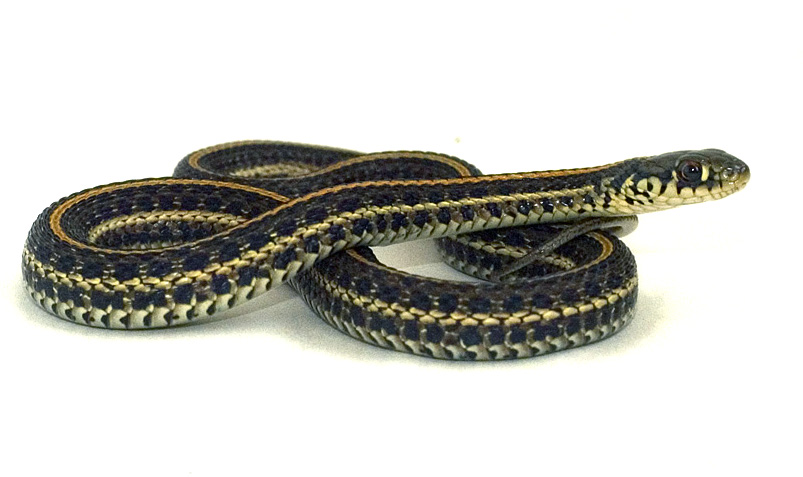
For more than a century, biologists who study snake embryos have noticed the same peculiar thing: long before a young snake can move its own muscles, its body is already curled into a tight, right-handed spiral inside the egg. No one had explained why the coil so consistently favors one direction — until now. A team led by researchers at the Canadian Museum of Nature reports that the spiral is not a behavior at all, but a simple mechanical consequence of one part of the embryo growing faster than another.
The study, published August 31 in the journal Current Biology, found that a snake embryo's body axis elongates much faster than its gut can keep pace. Because the two tissues are anchored to each other at either end but grow at different rates, the gut acts like a tether — what the authors call a "visceral pillar" — running through the middle of the coiling body. As the body outpaces the tether, it has nowhere to go but to buckle and twist, producing the spiral.
"It's like when you adjust the length of a strap and the longer, buckling side of the loop twists," said Tetsuto Miyashita, a research scientist at the Canadian Museum of Nature and the study's senior author.
A five-year survey of coiling embryos
The research team, led by Alexandra Weber — now at the University of British Columbia — analyzed more than 900 embryos representing 39 species of snakes and other limbless squamates, drawing on published literature, museum specimen photographs and new CT scans. The scans, conducted in part by co-author Raul Diaz of California State University, Los Angeles, revealed the internal architecture behind the coil for the first time: a slender column of gut tissue, wrapped in blood vessels from the yolk, running straight through the center of the spiraled body.
The finding marks a departure from how snake biologists have typically approached the animal's distinctive body plan. Much of the prior research into how snakes evolved their elongated, limbless anatomy has focused on genetics — the Hox genes and associated enhancers that govern the number and identity of vertebrae along the spine. The new results suggest that at least one signature feature of snake development, the embryonic coil itself, is not governed by that kind of genetic patterning at all, but is instead an emergent property of two tissues — the body axis and the gut — growing at different rates inside a shell that leaves no room to grow straight.
The direction of that first coil, the team found, is set by simple geometry rather than genetics. Because the yolk mass sits on the left side of the developing embryo, the lengthening body is pushed toward the opposite side, producing an initial right-handed, or dextral, bias. As the embryos mature and gain muscle control, many begin to reposition themselves, and by the time they are close to hatching the researchers found roughly equal numbers coiled in each direction — evidence that the early mechanical bias eventually gives way to active, muscle-driven movement.
Why it matters for the longest bodies among vertebrates
Snakes hatch with proportionally the longest bodies of any vertebrate animal, a body plan that depends on packing an extraordinarily elongated form into a comparatively small egg. The new findings suggest that coiling is not incidental to that packing problem but central to it: the same mechanical buckling that produces the spiral is what allows the embryo's axial skeleton to keep lengthening within the confined space of the shell, faster than the digestive tract that trails behind it.
The species examined ranged from small colubrids such as the Cape house snake (Boaedon capensis) and the plains garter snake (Thamnophis radix) to a broad swath of other limbless squamates, giving the team a comparative dataset large enough to show that the pattern holds broadly across snake evolution rather than being a quirk of one lineage.
"At these stages, the embryos don't have muscles to move with, so different forces are making them coil right-handed," said Weber, the study's lead author.
An unlikely origin during pandemic lockdowns
The project traces back to 2020, when pandemic restrictions closed labs and museum collections and Miyashita needed a research question his students could pursue without physical access to specimens. That constraint pushed the team toward archival photographs and published images rather than fresh dissections — an approach that ultimately let them assemble a far larger comparative sample, across far more species, than a single lab's live collection would have allowed.
- More than 900 embryos examined, from 39 species of snakes and limbless squamates
- The gut, or "visceral pillar," grows more slowly than the body axis, creating the tether that forces buckling
- The left-sided position of the yolk mass sets the initial rightward bias of the coil
- Near hatching, coiling direction becomes roughly evenly split as muscle control develops
What comes next
The authors say the finding opens a new line of inquiry into how mechanical forces, rather than genetic patterning alone, shape early animal development — a question with relevance well beyond snakes, since many elongated or coiled body structures across the animal kingdom face similar packing constraints inside an egg or womb. Miyashita's team has said it plans further comparative work examining whether related mechanical tethering shapes body-plan development in other limbless or highly elongated vertebrates, and whether the same left-right bias mechanism recurs across other coiling structures in nature.
The paper was published with support from Canadian and American research institutions, including the University of British Columbia, Carleton University, the University of Ottawa and the University of Helsinki, reflecting the multi-institution collaboration that grew out of the original 2020 project.

September Ranks as Earth's Second-Warmest on Record
Google Cuts a Key Quantum-Computing Error 40-Fold in First Real Hardware Test

A common salt mineral could preserve signs of life inside Enceladus's ocean, study finds
