Webb telescope finds the scars of planet-shattering collisions across two dozen young star systems
Astronomers using NASA's James Webb Space Telescope have identified a rare class of dusty young star systems bearing the chemical fingerprints of violent impacts between Mars-sized and Moon-sized bodies, offering scientists their clearest look yet at the kind of collision believed to have formed Earth's Moon.
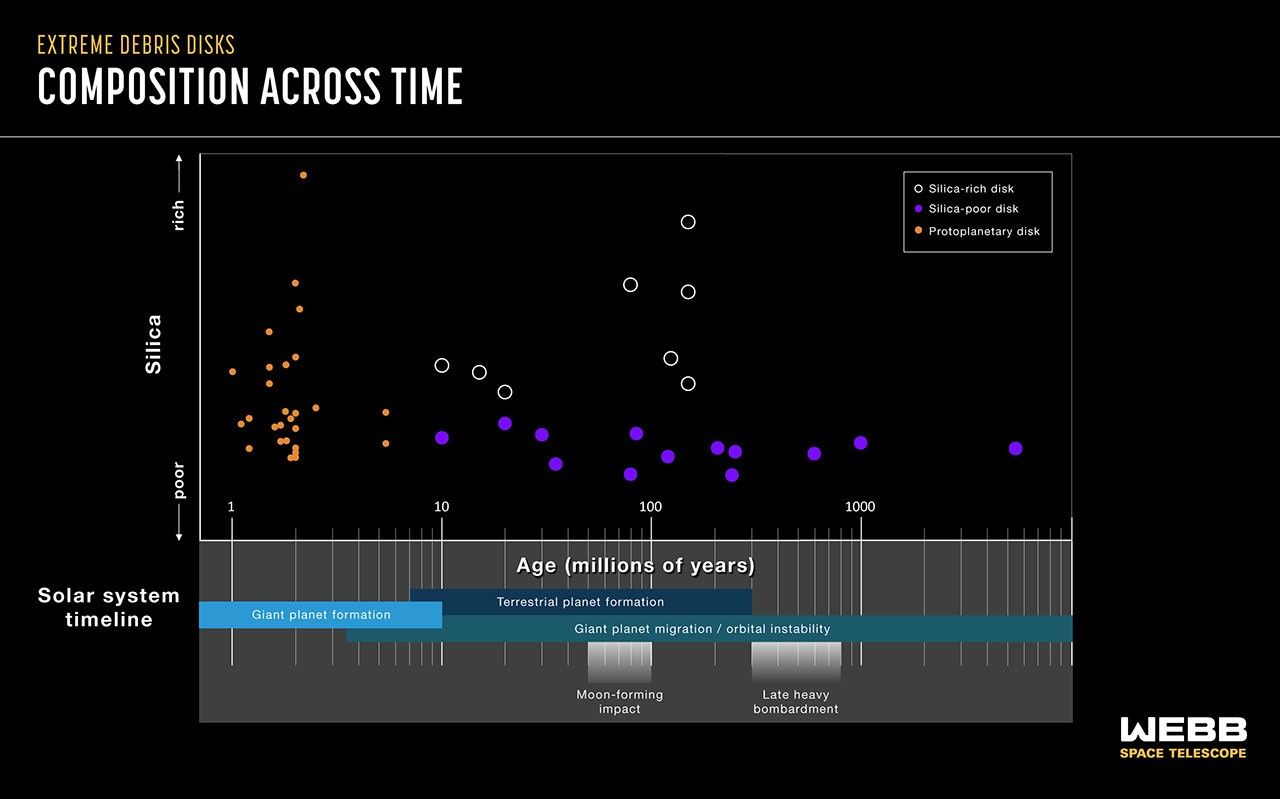
Astronomers using NASA's James Webb Space Telescope have assembled the largest catalog yet of young star systems carrying direct evidence of catastrophic planetary collisions, a discovery researchers say brings them closer to understanding the violent process that shaped the rocky planets of the solar system, including Earth.
The findings, published Oct. 1 in The Astrophysical Journal, focus on a rare category of objects called extreme debris disks: thick, churning belts of dust around young stars that are far brighter in infrared light than ordinary debris disks. Astronomers have long suspected that the dust in these systems is the debris of planetary bodies that smashed into one another, but until now they lacked enough examples, and enough detail, to say precisely what kinds of collisions were responsible.
Two kinds of cosmic wreckage
The research team, led by astronomer Kate Su of the Space Science Institute in Boulder, Colorado, used Webb's infrared spectrograph to examine the mineral composition of dust in 21 extreme debris disks, 16 of them observed directly by Webb and five drawn from archival data collected by NASA's retired Spitzer Space Telescope. The analysis, detailed in a preprint also posted to arXiv, sorted the disks into two distinct groups.
- About one-third of the systems are rich in silica, a mineral that forms only when rock is heated to extreme temperatures and partially vaporized. Researchers say these disks are the aftermath of high-energy collisions between Mars-sized bodies.
- The remaining two-thirds are silica-poor, pointing to less violent impacts between smaller, Moon-sized objects.
The silica-rich disks turned up only around stars younger than 300 million years, while the silica-poor disks appeared across a much wider range of stellar ages. Extreme debris disks of either kind are uncommon: Su's team estimates that only about 1 percent of young stars display the telltale infrared signature at any given time, a reflection of how brief and episodic these collisional events are on cosmic timescales.
A window onto Earth's own violent youth
The results bear directly on a question much closer to home: how Earth and its Moon came to be. The leading model of lunar formation holds that a Mars-sized protoplanet known as Theia struck the young Earth roughly 100 million years after the solar system formed, vaporizing rock and flinging debris into orbit that eventually coalesced into the Moon. Researchers say the silica-rich extreme debris disks, found only around stars younger than 300 million years, match that timeline and that type of impact closely, lending independent, outside-the-solar-system support to the Theia hypothesis.
"How rocky planets formed and giant planets evolved are part of the broader story of the solar system's formation. It's all one story," Su said in a statement released by NASA alongside the paper. "Our work on extreme debris disks helps us bring together the big picture of what we currently understand."
Scientists have known about extreme debris disks for roughly two decades, first spotted as unusual infrared excesses in data from Spitzer and other infrared observatories. But earlier instruments could not resolve the fine spectral detail needed to identify the minerals in the dust, leaving the underlying physics largely a matter of inference. Webb's mid-infrared instrument, launched in 2021, has made it possible to read the mineral composition of dust in systems hundreds of light-years away with a precision that was previously out of reach.
"Before Webb, we had limited information. We knew that they are weird and very different from the typical cold debris disks that we know, like Vega and Fomalhaut. Now that we have more data, we can pin down what these disks represent for planet formation and evolution," said Kate Su, lead author of the study.
Who is affected
The discovery has no direct bearing on life on Earth today, but it matters a great deal to the relatively small international community of astronomers who study how planetary systems, including the solar system, assemble themselves out of the gas and dust left over from a star's birth. Co-author Agnes Kospal, an astronomer at the Konkoly Observatory in Budapest, Hungary, said the Webb data offered a rare direct look at bodies that are otherwise impossible to observe.
"To just see their mid-infrared emission and beautiful spectral features with Webb, which allowed us to identify their compositions, was the most exciting thing for me," Kospal said. "We have no other way to study these planetary embryos directly because they are too small."
Attila Moor, also of the Konkoly Observatory and a co-author on the study, cautioned that the sample remains limited in places. Only three of the 21 systems examined were old enough to test whether silica-rich disks might, in rare cases, persist beyond the 300-million-year cutoff the team identified. "We expect no silica-rich systems among older extreme debris disks," Moor said. "We only have three disks in our sample that fit that age criteria, so it'll be nice to observe more of these systems to confirm our hypothesis."
What happens next
The research team said it plans to expand its survey to more young star systems to test the boundaries of the silica-rich and silica-poor categories and to search for systems that might straddle the two groups or evolve from one into the other over time. A larger sample would also help astronomers estimate more precisely how common Moon-forming-scale impacts were in the early histories of planetary systems generally, and whether the solar system's own violent adolescence was typical or unusual among stars like the Sun.
The study was conducted using Webb's Mid-Infrared Instrument, or MIRI, and drew on observations collected over the past several years as part of a broader Webb program targeting debris disks. NASA operates Webb in partnership with the European Space Agency and the Canadian Space Agency; the telescope is managed from the Goddard Space Flight Center in Greenbelt, Maryland, with science operations conducted by the Space Telescope Science Institute in Baltimore.

Squid bodies hide hundreds more hair cells than scientists knew, study finds

NASA, SpaceX launch Crew-13 to space station after three-week delay
Gut-targeted delivery could offer a needle-free path for mRNA vaccines and GLP-1 drugs
